Article Plan: 1 cm Grid Paper PDF
This article details everything about 1 cm grid paper in PDF format, covering its uses, sources for free downloads, customization options, and emerging digital trends.
1 cm grid paper, readily available as a PDF, is a foundational tool across numerous disciplines, from mathematics and engineering to art and scientific research. Its simple yet powerful structure – a network of evenly spaced one-centimeter squares – provides a precise framework for a wide array of tasks. This article serves as a comprehensive guide to understanding, utilizing, and sourcing this versatile resource.
We’ll explore the diverse types of 1 cm grid paper PDFs available, including standard grids, dot grids, and even isometric variations. Furthermore, we’ll delve into practical applications, customization techniques, and potential alternatives, ensuring you have the knowledge to effectively leverage this tool for your specific needs.
What is 1 cm Grid Paper?
1 cm grid paper is a type of graph paper characterized by a grid of squares, each measuring one centimeter by one centimeter. Typically presented as a PDF for easy access and printing, it provides a visual aid for accurate drawing, scaling, and measurement. The consistent grid spacing facilitates precise work in fields requiring dimensional accuracy.
Unlike graph paper with varying grid sizes, the 1 cm format offers a specific scale ideal for tasks needing millimeter precision. It’s commonly used for plotting graphs, designing layouts, and creating scaled diagrams. The PDF format ensures portability and compatibility across different devices and operating systems.
Why Use 1 cm Grid Paper?
1 cm grid paper offers unparalleled precision for various applications. Its consistent, easily measurable grid simplifies scaling diagrams, plotting data points, and creating accurate geometric constructions. The PDF format allows for convenient printing and digital annotation, making it versatile for both traditional and modern workflows.
Using this paper minimizes errors in design, engineering, and mathematical exercises. It’s particularly useful when a specific scale is required, like in architectural plans or scientific visualizations. The clear grid lines enhance readability and facilitate precise measurements, improving overall project accuracy and efficiency.
Types of 1 cm Grid Paper Available as PDFs
PDFs offer diverse 1 cm grid options, including standard grids, subtle dot grids for flexible sketching, isometric layouts, and even logarithmic scales for specialized tasks.
Standard 1 cm Grid Paper
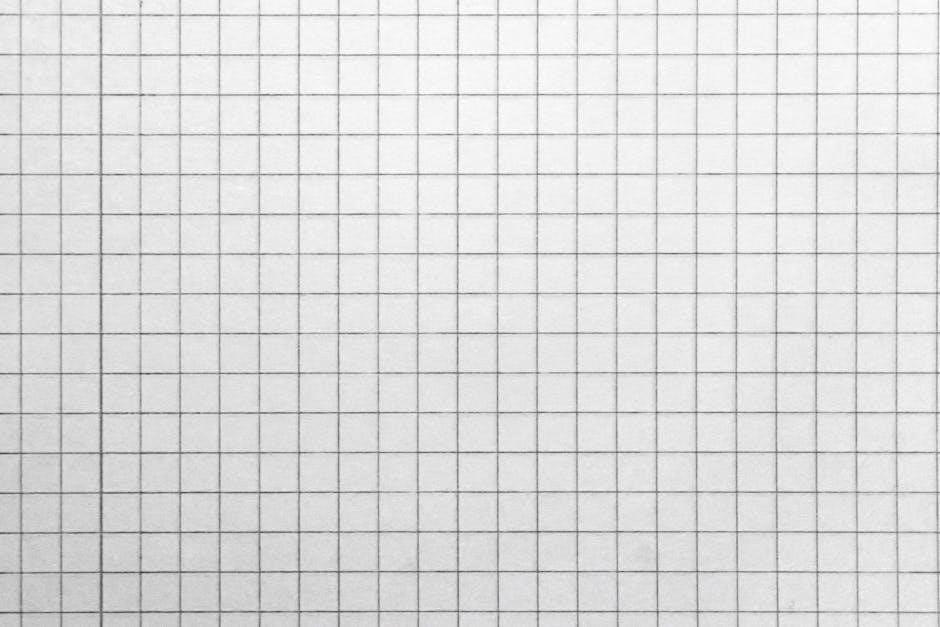
Traditional 1 cm grid paper features a network of evenly spaced, solid lines creating a precise matrix ideal for numerous applications. This format, readily available as a PDF, is fundamental for tasks demanding accuracy, like plotting graphs, designing layouts, or scaling drawings. The clear, defined grid facilitates easy measurement and visualization.
These PDFs typically present a clean, uncluttered appearance, maximizing usability. Users can easily print multiple copies for various projects. The consistent 1 cm spacing ensures uniformity across all generated sheets. It’s a cornerstone for students, engineers, and designers alike, offering a reliable foundation for precise work. Downloadable versions often come in standard paper sizes like A4 and Letter.
Dot Grid Paper (1 cm Equivalent)
Dot grid paper, while lacking solid lines, offers a versatile alternative, effectively mimicking a 1 cm grid through evenly spaced dots. These PDFs are popular for sketching, bullet journaling, and design work where a less intrusive grid is preferred. The subtle dot matrix provides structure without limiting creative freedom.
A common dot size is 0.8mm, designed to visually represent the 1 cm spacing. This format is excellent for freehand drawing and lettering, allowing for greater flexibility. Printable versions are easily found online, offering customizable page sizes. It’s favored by artists and planners seeking a balance between guidance and open space.
Isometric Grid Paper (Approximating 1 cm Scale)
Isometric grid paper presents a three-dimensional view on a two-dimensional surface, utilizing equilateral triangles to represent depth. While not a direct 1 cm grid, PDFs are available scaled to approximate this measurement for specific applications. This type is invaluable for technical drawings, architectural sketches, and visualizing 3D objects.
The grid’s angles (typically 30-60-90 degrees) allow for accurate representation of perspective. Finding a perfect 1 cm isometric scale can be challenging, often requiring adjustments during printing. It’s commonly used in engineering and design to illustrate complex structures and spatial relationships.
Logarithmic Grid Paper (with 1 cm Considerations)
Logarithmic grid paper isn’t designed with a fixed 1 cm scale, but PDFs can be adapted for use where logarithmic relationships need visualization. The spacing increases exponentially, ideal for representing data with wide ranges, like sound frequencies or pH levels. While a direct 1 cm correlation isn’t present, understanding the logarithmic scale is crucial.
Users might need to adjust printing settings or overlay a 1 cm grid for reference. This paper type is less common but essential in scientific fields. It’s particularly useful when plotting data where proportional changes are more important than absolute values.

Where to Find & Download 1 cm Grid Paper PDFs
Numerous websites offer free, printable 1 cm grid paper PDFs, including Gridzzly.com and educational resource sites, alongside software for custom creation.
Free Printable Grid Paper Websites
Several websites specialize in providing free, downloadable grid paper, including options suitable for 1 cm grids. Gridzzly.com stands out, allowing users to generate custom templates with adjustable line styles, spacing, and paper sizes – perfect for tailoring the grid to specific needs. Other sites offer pre-made 1 cm grid paper PDFs ready for immediate download and printing.
These resources are invaluable for students, teachers, and professionals seeking a quick and convenient solution for tasks requiring a precise grid. The availability of various formats, like PDF and Word documents, ensures compatibility across different devices and operating systems. Users can easily find and access the desired grid paper without any cost or registration requirements, making these websites highly accessible.
Educational Resource Websites
Many educational websites offer free printable 1 cm grid paper as part of their resource libraries. These platforms often cater to mathematics and science education, providing grid paper specifically designed for geometry, algebra, and data plotting exercises. Resources are frequently bundled with lesson plans or activity ideas, enhancing their pedagogical value.
Examples include sites dedicated to math worksheets and teacher resources. These websites prioritize accuracy and clarity, ensuring the grid lines are precise and easy to read. Downloading from these sources guarantees quality and relevance to educational purposes, supporting effective learning and skill development for students of all levels.
Software for Creating Custom Grid Paper
Several software options empower users to design and generate personalized 1 cm grid paper PDFs. Gridzzly.com stands out, allowing precise control over line styles, spacing, and paper sizes. This is ideal for tailoring grid paper to specific project needs, beyond standard templates.
Beyond dedicated grid paper tools, general design software like Adobe Illustrator or Inkscape can also be utilized. These programs offer greater flexibility in customization, including adjusting line weight, color, and adding elements like margins or headers. Creating custom PDFs ensures a perfect fit for unique applications, maximizing usability and efficiency.

Using 1 cm Grid Paper PDFs
1 cm grid paper PDFs are versatile for digital annotation and printing, offering options for A4 or Letter sizes, and requiring careful printer settings.
Digital Use (Viewing & Annotation)
1 cm grid paper PDFs excel in digital environments, offering a practical surface for various tasks. Utilizing PDF viewers or annotation software allows users to sketch diagrams, plan layouts, or solve mathematical problems directly on the grid. This eliminates the need for physical paper and provides a readily shareable format.
Many tablets and touchscreen devices support stylus input, enhancing precision when working with the 1 cm grid. Features like layers and undo/redo functions within annotation tools further streamline the digital workflow. Furthermore, these PDFs are ideal for online collaboration, enabling multiple users to view and contribute to the same grid simultaneously, fostering teamwork and efficient project development.
Printing Considerations
Successfully printing 1 cm grid paper PDFs requires attention to detail. Ensure your printer settings are configured for the correct paper size – commonly A4 or Letter – and that scaling is set to “100%” or “Actual Size” to maintain the accurate 1 cm grid spacing. Previewing the print job is crucial to verify the grid’s integrity before committing to paper.
Printer quality impacts line clarity; higher resolution settings yield sharper grids. Consider paper weight; thicker paper prevents bleed-through from pens or markers. Test prints are recommended to fine-tune settings for optimal results. Incorrect scaling can distort measurements, rendering the grid useless for precise work, so double-checking is essential.
Paper Size Options (A4, Letter, etc.)
1 cm grid paper PDFs are readily available in various standard paper sizes, catering to diverse regional and user preferences. A4 (210 x 297 mm) is prevalent internationally, while Letter (8.5 x 11 inches) dominates in North America. Other options include Legal size and smaller formats for specific applications.
When downloading or creating PDFs, selecting the appropriate paper size is vital for accurate printing and usability. Ensure your printer supports the chosen size. Custom grid paper generators often allow size selection, offering flexibility. Consider the intended use; larger sizes accommodate bigger designs or datasets.
Applications of 1 cm Grid Paper
1 cm grid paper serves diverse fields, including mathematics for precise geometry, engineering design, artistic layouts, and scientific data visualization, offering scalable precision.
Mathematics (Geometry, Algebra)
For mathematics students and educators, 1 cm grid paper PDFs are invaluable tools. In geometry, the precise 1 cm grid facilitates accurate drawing of shapes, aiding in understanding area, perimeter, and spatial relationships. Visualizing geometric proofs becomes simpler with clear, scaled diagrams.
Algebraic concepts, like graphing linear equations and plotting coordinate points, benefit significantly from the grid’s structure. Students can easily represent functions and analyze their properties. Furthermore, the grid assists in understanding concepts like scaling and transformations. A maths game utilizing 1cm grid paper enhances learning multiplication, division, and area calculations, making abstract concepts more tangible.
Engineering & Design
1 cm grid paper PDFs serve as foundational tools in various engineering and design disciplines. Architects and engineers utilize the precise grid for sketching preliminary designs, scaling blueprints, and visualizing spatial arrangements. The 1 cm scale allows for accurate representation of dimensions and proportions, crucial for project planning.
Designers employ grid paper for layout planning, ensuring consistency and visual balance in their creations. It’s beneficial for prototyping, creating mockups, and iterating on designs. The ability to easily reconstruct asymptotic series expansions, as demonstrated in related research, highlights the grid’s utility in complex calculations and modeling.
Art & Graphic Design
1 cm grid paper PDFs offer artists and graphic designers a structured foundation for creative projects. The grid facilitates precise drawing, pixel art creation, and the development of repeating patterns. Designers can utilize the 1 cm scale for accurate logo design, icon creation, and typography layouts, ensuring visual harmony and balance.
Artists find the grid helpful for proportion studies, perspective drawing, and creating detailed illustrations. It’s particularly useful for digital artists transitioning to traditional media or vice versa. The consistent spacing aids in achieving clean lines and controlled compositions, enhancing the overall aesthetic quality of artwork.
Scientific Data Plotting
1 cm grid paper PDFs are invaluable tools for scientists and researchers needing to visualize data manually. The precise 1 cm grid allows for accurate plotting of data points, creation of graphs, and analysis of trends. This is particularly useful in fields like physics, chemistry, and biology where precise representation is crucial.
Researchers can easily sketch curves, calculate areas, and identify correlations within datasets. While digital tools are prevalent, the simplicity of grid paper offers a quick and accessible method for preliminary data exploration and visual assessment before employing complex software. It’s ideal for field work or situations lacking immediate digital access.

Customizing 1 cm Grid Paper PDFs
PDFs allow adjustments to line weight, color, and the addition of margins or headers, enabling tailored templates for specific needs and enhanced usability.
Adjusting Line Weight & Color
Customization extends to the visual properties of the grid itself. Users can modify the line weight, controlling the thickness of the gridlines for clarity or subtlety. Thicker lines are beneficial for bold visual separation, while thinner lines offer a cleaner, less intrusive appearance.
Furthermore, the color of the gridlines is readily adjustable. While traditional black lines are common, alternative colors like blue or gray can reduce eye strain during prolonged use or enhance contrast with specific content. Software tools and online generators often provide a color palette or allow for custom RGB/Hex code input, granting precise control over the grid’s aesthetic.
Adding Margins & Headers
Enhancing PDF grid paper often involves incorporating margins and headers. Margins provide blank space around the grid, preventing content from being cut off during printing and offering room for annotations or labels. Customizable margin sizes cater to diverse printing setups and user preferences.
Headers allow for the inclusion of identifying information, such as dates, project titles, or page numbers. This is particularly useful for multi-page documents or collaborative projects. Software tools enable easy header creation and placement, ensuring consistent branding or organization across all grid paper sheets.
Creating Templates with Pre-printed Elements
Beyond basic grids, PDF customization extends to pre-printed templates. These templates integrate common elements directly onto the grid paper, streamlining specific tasks. Examples include pre-labeled axes for graphing, scaled diagrams for engineering, or designated areas for data input in scientific experiments.
Such templates save time and reduce errors by providing a structured framework. Users can design and save their own custom templates for repeated use, tailoring the grid paper to their unique needs. This feature is invaluable for educators, designers, and professionals requiring consistent layouts.

Alternatives to 1 cm Grid Paper
Various options exist beyond 1 cm grids, including different grid sizes, digital tools like Gridzzly, and spreadsheet software offering flexible grid creation.
Graph Paper with Different Grid Sizes
While 1 cm grid paper serves specific needs, numerous alternatives utilize varying grid dimensions. Smaller grids, like 5 mm or even 2 mm, offer increased precision for detailed work, beneficial in technical drawings or intricate designs. Conversely, larger grids – 2 cm or 5 cm – are suitable for broader layouts, sketching, or quick estimations where extreme accuracy isn’t paramount.
The choice depends on the application; for example, a 10 mm (1 cm) square grid paper template is readily available for download. Different colored grids, such as blue, can also enhance visibility and reduce eye strain. Exploring these alternatives provides flexibility and caters to diverse project requirements beyond the standard 1 cm spacing.
Digital Grid Tools
Beyond traditional PDFs, a range of digital tools replicate and even enhance the functionality of 1 cm grid paper. Software like Gridzzly.com allows for the creation of custom grid templates, offering adjustable line styles, spacing, and paper sizes – surpassing the limitations of pre-printed sheets. These tools often feature layers, enabling users to toggle grid visibility for cleaner designs.
Furthermore, drawing applications and graphic design software frequently include grid functionalities. These digital grids can be precisely set to 1 cm increments, providing a dynamic and adaptable workspace. This eliminates the need for printing and offers features like zooming and undo/redo, boosting efficiency.
Using Spreadsheet Software
Spreadsheet programs like Microsoft Excel or Google Sheets present a surprisingly effective alternative to 1 cm grid paper PDFs. By adjusting cell sizes to represent 1 cm squares – approximately 28.35 pixels at standard resolution – a functional grid emerges. Users can manipulate row heights and column widths for precise scaling.
This method allows for easy data entry directly onto the grid, and formulas can be used for calculations related to areas or dimensions plotted on the grid. While not visually identical to traditional grid paper, spreadsheets offer powerful analytical capabilities alongside the grid layout, making them suitable for mathematical tasks.
Troubleshooting PDF Issues
Common problems with 1 cm grid paper PDFs include printing errors, display inconsistencies, and security restrictions preventing modification or printing – solutions are readily available.
PDF Not Printing Correctly
If your 1 cm grid paper PDF isn’t printing as expected, several factors could be at play. First, ensure your printer drivers are up-to-date; outdated drivers often cause formatting issues. Secondly, verify the print settings within your PDF viewer – confirm the correct paper size (A4 or Letter) is selected and that scaling is set to ‘Actual Size’ or 100% to prevent distortion of the 1 cm grid.
Also, check if the PDF is set to print in grayscale, potentially losing crucial grid line visibility. Finally, try printing a different PDF to isolate whether the problem lies with the file itself or your printer configuration. A test print can quickly diagnose the root cause.
PDF Displaying Incorrectly
When a 1 cm grid paper PDF appears distorted or with incorrect scaling on your screen, the issue often stems from your PDF viewer’s settings or compatibility. Ensure you’re using an updated version of Adobe Acrobat Reader or a comparable PDF program. Within the viewer, check the ‘Page Scaling’ option; it should be set to ‘None’ or ‘Actual Size’ to display the grid accurately.
Furthermore, zoom levels can sometimes introduce visual discrepancies. Try resetting the zoom to 100%. If problems persist, a corrupted PDF file might be the cause – attempt downloading the file again from the source.
PDF Security Restrictions
Some 1 cm grid paper PDFs may have security restrictions imposed by the creator, limiting functionalities like printing, copying, or editing. These restrictions are designed to protect the document’s integrity or enforce copyright. If you encounter a password prompt when attempting to save or modify the PDF, it indicates such a restriction is in place.
Legally circumventing these restrictions is generally prohibited; However, if you legitimately require access and possess the necessary permissions, contact the PDF’s source for assistance in removing the security settings.
Future Trends in Grid Paper Technology
Interactive digital grid paper, CAD integration, and AI-powered grid generation are poised to revolutionize how we utilize and customize 1 cm grid paper PDFs.
Interactive Digital Grid Paper
The evolution of 1 cm grid paper is leaning towards dynamic, interactive digital formats. Imagine PDFs that allow direct annotation, measurements taken within the grid itself, and real-time calculations based on plotted data. This goes beyond simple viewing and printing; it’s about actively using the grid within a digital environment.
Such platforms could integrate with drawing tools, enabling users to sketch designs directly onto the grid. Furthermore, interactive features might include automatic shape recognition or the ability to export designs to other software formats seamlessly. This represents a significant leap from static printable PDFs, offering a more versatile and efficient workflow for students, designers, and engineers alike.
Integration with CAD Software
A key future trend involves seamless integration of 1 cm grid paper PDFs with Computer-Aided Design (CAD) software. Currently, designs often start on grid paper for initial sketching and then are transferred to CAD for precise detailing. Direct integration would eliminate this intermediary step, streamlining the design process.
Imagine importing a scanned or digitally created 1 cm grid PDF directly into CAD, where the grid lines are recognized as a foundational layer. This would allow designers to build upon initial sketches with CAD’s precision tools, maintaining scale and proportions effortlessly. This synergy promises increased efficiency and reduced errors.
AI-Powered Grid Generation
The future of 1 cm grid paper PDFs may lie in Artificial Intelligence (AI)-driven generation. Imagine an AI capable of creating customized grid paper based on specific user needs – automatically adjusting line weights, colors, and even incorporating pre-printed elements like scales or logos.
Furthermore, AI could analyze a user’s intended application (e.g., architectural plan, circuit diagram) and generate a grid optimized for that purpose. This goes beyond simple customization; it’s intelligent grid design. Such tools would dramatically enhance productivity and accessibility for diverse users.